•  
Sunflower Field Illustrations - Spain

Sunflower Field Illustrations - Spain

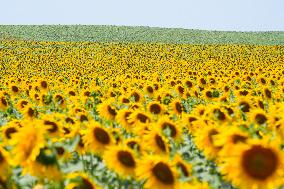
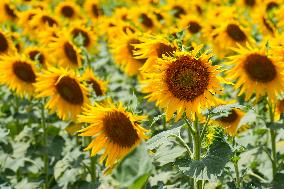
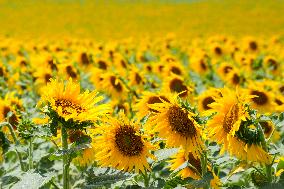
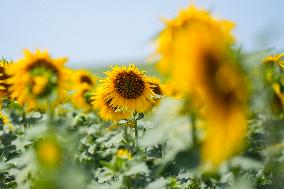
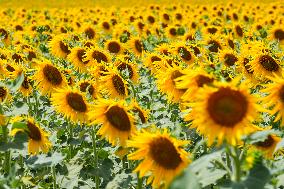
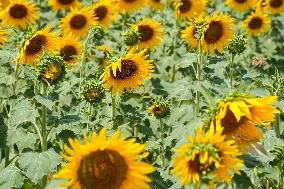
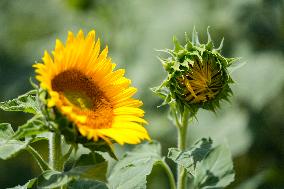
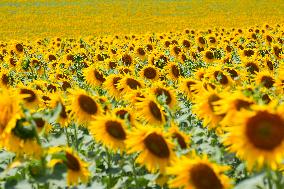
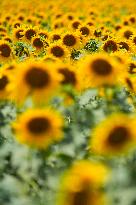
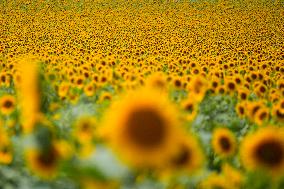
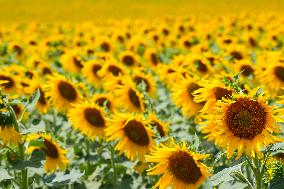
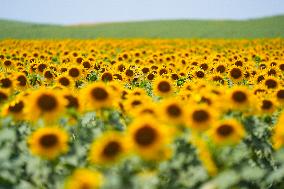
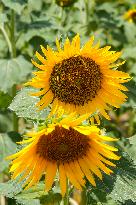
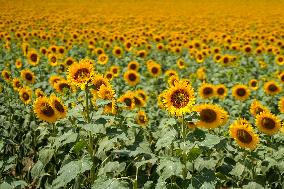
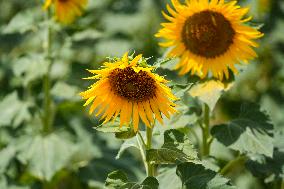
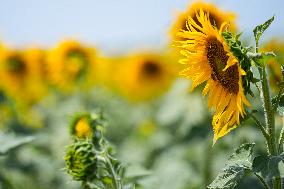
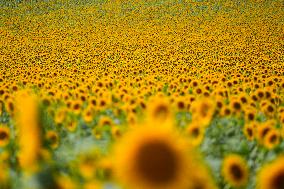
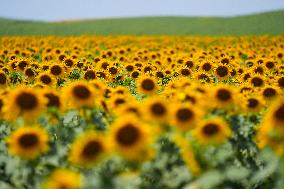
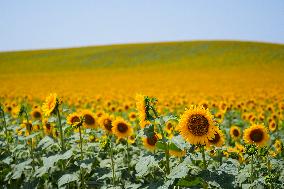
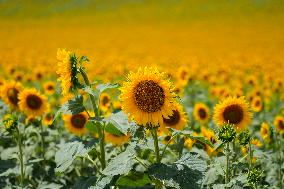
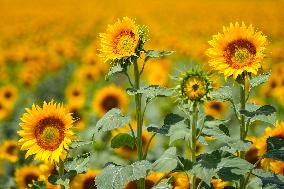
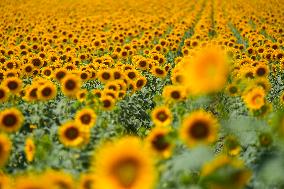
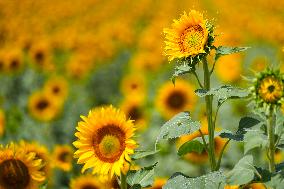
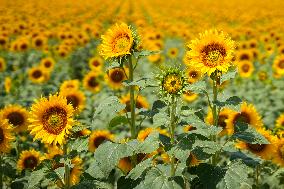
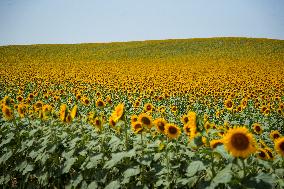
Images of a field of sunflowers in bloom in the Sevillian town of Sanlucar la Mayor, on June 20, 2025, in Seville, Andalusia, Spain. This Saturday, June 21, at 2 hours 42 minutes UTC, according to calculations by the National Astronomical Observatory, the summer solstice will occur, a phenomenon in which the Sun reaches its maximum declination projecting its light over the maximum geographic latitude on Earth. This astronomical event starts the summer in the northern hemisphere and the winter in the southern hemisphere. In addition, the day of the summer solstice corresponds to the longest day of the year, since it is the day on which the Sun rises the earliest and the day on which it sets the latest. Photo by Joaquin Corchero/Europa Press/ABACAPRESS.COM

  •  
Sunflower Field Illustrations - Spain

Sunflower Field Illustrations - Spain

Images of a field of sunflowers in bloom in the Sevillian town of Sanlucar la Mayor, on June 20, 2025, in Seville, Andalusia, Spain. This Saturday, June 21, at 2 hours 42 minutes UTC, according to calculations by the National Astronomical Observatory, the summer solstice will occur, a phenomenon in which the Sun reaches its maximum declination projecting its light over the maximum geographic latitude on Earth. This astronomical event starts the summer in the northern hemisphere and the winter in the southern hemisphere. In addition, the day of the summer solstice corresponds to the longest day of the year, since it is the day on which the Sun rises the earliest and the day on which it sets the latest. Photo by Joaquin Corchero/Europa Press/ABACAPRESS.COM

  •  
Sunflower Field Illustrations - Spain

Sunflower Field Illustrations - Spain

Images of a field of sunflowers in bloom in the Sevillian town of Sanlucar la Mayor, on June 20, 2025, in Seville, Andalusia, Spain. This Saturday, June 21, at 2 hours 42 minutes UTC, according to calculations by the National Astronomical Observatory, the summer solstice will occur, a phenomenon in which the Sun reaches its maximum declination projecting its light over the maximum geographic latitude on Earth. This astronomical event starts the summer in the northern hemisphere and the winter in the southern hemisphere. In addition, the day of the summer solstice corresponds to the longest day of the year, since it is the day on which the Sun rises the earliest and the day on which it sets the latest. Photo by Joaquin Corchero/Europa Press/ABACAPRESS.COM

  •  
Sunflower Field Illustrations - Spain

Sunflower Field Illustrations - Spain

Images of a field of sunflowers in bloom in the Sevillian town of Sanlucar la Mayor, on June 20, 2025, in Seville, Andalusia, Spain. This Saturday, June 21, at 2 hours 42 minutes UTC, according to calculations by the National Astronomical Observatory, the summer solstice will occur, a phenomenon in which the Sun reaches its maximum declination projecting its light over the maximum geographic latitude on Earth. This astronomical event starts the summer in the northern hemisphere and the winter in the southern hemisphere. In addition, the day of the summer solstice corresponds to the longest day of the year, since it is the day on which the Sun rises the earliest and the day on which it sets the latest. Photo by Joaquin Corchero/Europa Press/ABACAPRESS.COM

  •  
Sunflower Field Illustrations - Spain

Sunflower Field Illustrations - Spain

Images of a field of sunflowers in bloom in the Sevillian town of Sanlucar la Mayor, on June 20, 2025, in Seville, Andalusia, Spain. This Saturday, June 21, at 2 hours 42 minutes UTC, according to calculations by the National Astronomical Observatory, the summer solstice will occur, a phenomenon in which the Sun reaches its maximum declination projecting its light over the maximum geographic latitude on Earth. This astronomical event starts the summer in the northern hemisphere and the winter in the southern hemisphere. In addition, the day of the summer solstice corresponds to the longest day of the year, since it is the day on which the Sun rises the earliest and the day on which it sets the latest. Photo by Joaquin Corchero/Europa Press/ABACAPRESS.COM

  •  
Sunflower Field Illustrations - Spain

Sunflower Field Illustrations - Spain

Images of a field of sunflowers in bloom in the Sevillian town of Sanlucar la Mayor, on June 20, 2025, in Seville, Andalusia, Spain. This Saturday, June 21, at 2 hours 42 minutes UTC, according to calculations by the National Astronomical Observatory, the summer solstice will occur, a phenomenon in which the Sun reaches its maximum declination projecting its light over the maximum geographic latitude on Earth. This astronomical event starts the summer in the northern hemisphere and the winter in the southern hemisphere. In addition, the day of the summer solstice corresponds to the longest day of the year, since it is the day on which the Sun rises the earliest and the day on which it sets the latest. Photo by Joaquin Corchero/Europa Press/ABACAPRESS.COM

  •  
Sunflower Field Illustrations - Spain

Sunflower Field Illustrations - Spain

Images of a field of sunflowers in bloom in the Sevillian town of Sanlucar la Mayor, on June 20, 2025, in Seville, Andalusia, Spain. This Saturday, June 21, at 2 hours 42 minutes UTC, according to calculations by the National Astronomical Observatory, the summer solstice will occur, a phenomenon in which the Sun reaches its maximum declination projecting its light over the maximum geographic latitude on Earth. This astronomical event starts the summer in the northern hemisphere and the winter in the southern hemisphere. In addition, the day of the summer solstice corresponds to the longest day of the year, since it is the day on which the Sun rises the earliest and the day on which it sets the latest. Photo by Joaquin Corchero/Europa Press/ABACAPRESS.COM

  •  
Sunflower Field Illustrations - Spain

Sunflower Field Illustrations - Spain

Images of a field of sunflowers in bloom in the Sevillian town of Sanlucar la Mayor, on June 20, 2025, in Seville, Andalusia, Spain. This Saturday, June 21, at 2 hours 42 minutes UTC, according to calculations by the National Astronomical Observatory, the summer solstice will occur, a phenomenon in which the Sun reaches its maximum declination projecting its light over the maximum geographic latitude on Earth. This astronomical event starts the summer in the northern hemisphere and the winter in the southern hemisphere. In addition, the day of the summer solstice corresponds to the longest day of the year, since it is the day on which the Sun rises the earliest and the day on which it sets the latest. Photo by Joaquin Corchero/Europa Press/ABACAPRESS.COM

  •  
Sunflower Field Illustrations - Spain

Sunflower Field Illustrations - Spain

Images of a field of sunflowers in bloom in the Sevillian town of Sanlucar la Mayor, on June 20, 2025, in Seville, Andalusia, Spain. This Saturday, June 21, at 2 hours 42 minutes UTC, according to calculations by the National Astronomical Observatory, the summer solstice will occur, a phenomenon in which the Sun reaches its maximum declination projecting its light over the maximum geographic latitude on Earth. This astronomical event starts the summer in the northern hemisphere and the winter in the southern hemisphere. In addition, the day of the summer solstice corresponds to the longest day of the year, since it is the day on which the Sun rises the earliest and the day on which it sets the latest. Photo by Joaquin Corchero/Europa Press/ABACAPRESS.COM

  •  
Sunflower Field Illustrations - Spain

Sunflower Field Illustrations - Spain

Images of a field of sunflowers in bloom in the Sevillian town of Sanlucar la Mayor, on June 20, 2025, in Seville, Andalusia, Spain. This Saturday, June 21, at 2 hours 42 minutes UTC, according to calculations by the National Astronomical Observatory, the summer solstice will occur, a phenomenon in which the Sun reaches its maximum declination projecting its light over the maximum geographic latitude on Earth. This astronomical event starts the summer in the northern hemisphere and the winter in the southern hemisphere. In addition, the day of the summer solstice corresponds to the longest day of the year, since it is the day on which the Sun rises the earliest and the day on which it sets the latest. Photo by Joaquin Corchero/Europa Press/ABACAPRESS.COM

  •  
Sunflower Field Illustrations - Spain

Sunflower Field Illustrations - Spain

Images of a field of sunflowers in bloom in the Sevillian town of Sanlucar la Mayor, on June 20, 2025, in Seville, Andalusia, Spain. This Saturday, June 21, at 2 hours 42 minutes UTC, according to calculations by the National Astronomical Observatory, the summer solstice will occur, a phenomenon in which the Sun reaches its maximum declination projecting its light over the maximum geographic latitude on Earth. This astronomical event starts the summer in the northern hemisphere and the winter in the southern hemisphere. In addition, the day of the summer solstice corresponds to the longest day of the year, since it is the day on which the Sun rises the earliest and the day on which it sets the latest. Photo by Joaquin Corchero/Europa Press/ABACAPRESS.COM

  •  
Sunflower Field Illustrations - Spain

Sunflower Field Illustrations - Spain

Images of a field of sunflowers in bloom in the Sevillian town of Sanlucar la Mayor, on June 20, 2025, in Seville, Andalusia, Spain. This Saturday, June 21, at 2 hours 42 minutes UTC, according to calculations by the National Astronomical Observatory, the summer solstice will occur, a phenomenon in which the Sun reaches its maximum declination projecting its light over the maximum geographic latitude on Earth. This astronomical event starts the summer in the northern hemisphere and the winter in the southern hemisphere. In addition, the day of the summer solstice corresponds to the longest day of the year, since it is the day on which the Sun rises the earliest and the day on which it sets the latest. Photo by Joaquin Corchero/Europa Press/ABACAPRESS.COM

  •  
Sunflower Field Illustrations - Spain

Sunflower Field Illustrations - Spain

Images of a field of sunflowers in bloom in the Sevillian town of Sanlucar la Mayor, on June 20, 2025, in Seville, Andalusia, Spain. This Saturday, June 21, at 2 hours 42 minutes UTC, according to calculations by the National Astronomical Observatory, the summer solstice will occur, a phenomenon in which the Sun reaches its maximum declination projecting its light over the maximum geographic latitude on Earth. This astronomical event starts the summer in the northern hemisphere and the winter in the southern hemisphere. In addition, the day of the summer solstice corresponds to the longest day of the year, since it is the day on which the Sun rises the earliest and the day on which it sets the latest. Photo by Joaquin Corchero/Europa Press/ABACAPRESS.COM

  •  
Sunflower Field Illustrations - Spain

Sunflower Field Illustrations - Spain

Images of a field of sunflowers in bloom in the Sevillian town of Sanlucar la Mayor, on June 20, 2025, in Seville, Andalusia, Spain. This Saturday, June 21, at 2 hours 42 minutes UTC, according to calculations by the National Astronomical Observatory, the summer solstice will occur, a phenomenon in which the Sun reaches its maximum declination projecting its light over the maximum geographic latitude on Earth. This astronomical event starts the summer in the northern hemisphere and the winter in the southern hemisphere. In addition, the day of the summer solstice corresponds to the longest day of the year, since it is the day on which the Sun rises the earliest and the day on which it sets the latest. Photo by Joaquin Corchero/Europa Press/ABACAPRESS.COM

  •  
Sunflower Field Illustrations - Spain

Sunflower Field Illustrations - Spain

Images of a field of sunflowers in bloom in the Sevillian town of Sanlucar la Mayor, on June 20, 2025, in Seville, Andalusia, Spain. This Saturday, June 21, at 2 hours 42 minutes UTC, according to calculations by the National Astronomical Observatory, the summer solstice will occur, a phenomenon in which the Sun reaches its maximum declination projecting its light over the maximum geographic latitude on Earth. This astronomical event starts the summer in the northern hemisphere and the winter in the southern hemisphere. In addition, the day of the summer solstice corresponds to the longest day of the year, since it is the day on which the Sun rises the earliest and the day on which it sets the latest. Photo by Joaquin Corchero/Europa Press/ABACAPRESS.COM

  •  
Sunflower Field Illustrations - Spain

Sunflower Field Illustrations - Spain

Images of a field of sunflowers in bloom in the Sevillian town of Sanlucar la Mayor, on June 20, 2025, in Seville, Andalusia, Spain. This Saturday, June 21, at 2 hours 42 minutes UTC, according to calculations by the National Astronomical Observatory, the summer solstice will occur, a phenomenon in which the Sun reaches its maximum declination projecting its light over the maximum geographic latitude on Earth. This astronomical event starts the summer in the northern hemisphere and the winter in the southern hemisphere. In addition, the day of the summer solstice corresponds to the longest day of the year, since it is the day on which the Sun rises the earliest and the day on which it sets the latest. Photo by Joaquin Corchero/Europa Press/ABACAPRESS.COM

  •  
Sunflower Field Illustrations - Spain

Sunflower Field Illustrations - Spain

Images of a field of sunflowers in bloom in the Sevillian town of Sanlucar la Mayor, on June 20, 2025, in Seville, Andalusia, Spain. This Saturday, June 21, at 2 hours 42 minutes UTC, according to calculations by the National Astronomical Observatory, the summer solstice will occur, a phenomenon in which the Sun reaches its maximum declination projecting its light over the maximum geographic latitude on Earth. This astronomical event starts the summer in the northern hemisphere and the winter in the southern hemisphere. In addition, the day of the summer solstice corresponds to the longest day of the year, since it is the day on which the Sun rises the earliest and the day on which it sets the latest. Photo by Joaquin Corchero/Europa Press/ABACAPRESS.COM

  •  
Sunflower Field Illustrations - Spain

Sunflower Field Illustrations - Spain

Images of a field of sunflowers in bloom in the Sevillian town of Sanlucar la Mayor, on June 20, 2025, in Seville, Andalusia, Spain. This Saturday, June 21, at 2 hours 42 minutes UTC, according to calculations by the National Astronomical Observatory, the summer solstice will occur, a phenomenon in which the Sun reaches its maximum declination projecting its light over the maximum geographic latitude on Earth. This astronomical event starts the summer in the northern hemisphere and the winter in the southern hemisphere. In addition, the day of the summer solstice corresponds to the longest day of the year, since it is the day on which the Sun rises the earliest and the day on which it sets the latest. Photo by Joaquin Corchero/Europa Press/ABACAPRESS.COM

  •  
Sunflower Field Illustrations - Spain

Sunflower Field Illustrations - Spain

Images of a field of sunflowers in bloom in the Sevillian town of Sanlucar la Mayor, on June 20, 2025, in Seville, Andalusia, Spain. This Saturday, June 21, at 2 hours 42 minutes UTC, according to calculations by the National Astronomical Observatory, the summer solstice will occur, a phenomenon in which the Sun reaches its maximum declination projecting its light over the maximum geographic latitude on Earth. This astronomical event starts the summer in the northern hemisphere and the winter in the southern hemisphere. In addition, the day of the summer solstice corresponds to the longest day of the year, since it is the day on which the Sun rises the earliest and the day on which it sets the latest. Photo by Joaquin Corchero/Europa Press/ABACAPRESS.COM

  •  
Sunflower Field Illustrations - Spain

Sunflower Field Illustrations - Spain

Images of a field of sunflowers in bloom in the Sevillian town of Sanlucar la Mayor, on June 20, 2025, in Seville, Andalusia, Spain. This Saturday, June 21, at 2 hours 42 minutes UTC, according to calculations by the National Astronomical Observatory, the summer solstice will occur, a phenomenon in which the Sun reaches its maximum declination projecting its light over the maximum geographic latitude on Earth. This astronomical event starts the summer in the northern hemisphere and the winter in the southern hemisphere. In addition, the day of the summer solstice corresponds to the longest day of the year, since it is the day on which the Sun rises the earliest and the day on which it sets the latest. Photo by Joaquin Corchero/Europa Press/ABACAPRESS.COM

  •  
Sunflower Field Illustrations - Spain

Sunflower Field Illustrations - Spain

Images of a field of sunflowers in bloom in the Sevillian town of Sanlucar la Mayor, on June 20, 2025, in Seville, Andalusia, Spain. This Saturday, June 21, at 2 hours 42 minutes UTC, according to calculations by the National Astronomical Observatory, the summer solstice will occur, a phenomenon in which the Sun reaches its maximum declination projecting its light over the maximum geographic latitude on Earth. This astronomical event starts the summer in the northern hemisphere and the winter in the southern hemisphere. In addition, the day of the summer solstice corresponds to the longest day of the year, since it is the day on which the Sun rises the earliest and the day on which it sets the latest. Photo by Joaquin Corchero/Europa Press/ABACAPRESS.COM

  •  
Sunflower Field Illustrations - Spain

Sunflower Field Illustrations - Spain

Images of a field of sunflowers in bloom in the Sevillian town of Sanlucar la Mayor, on June 20, 2025, in Seville, Andalusia, Spain. This Saturday, June 21, at 2 hours 42 minutes UTC, according to calculations by the National Astronomical Observatory, the summer solstice will occur, a phenomenon in which the Sun reaches its maximum declination projecting its light over the maximum geographic latitude on Earth. This astronomical event starts the summer in the northern hemisphere and the winter in the southern hemisphere. In addition, the day of the summer solstice corresponds to the longest day of the year, since it is the day on which the Sun rises the earliest and the day on which it sets the latest. Photo by Joaquin Corchero/Europa Press/ABACAPRESS.COM

  •  
Sunflower Field Illustrations - Spain

Sunflower Field Illustrations - Spain

Images of a field of sunflowers in bloom in the Sevillian town of Sanlucar la Mayor, on June 20, 2025, in Seville, Andalusia, Spain. This Saturday, June 21, at 2 hours 42 minutes UTC, according to calculations by the National Astronomical Observatory, the summer solstice will occur, a phenomenon in which the Sun reaches its maximum declination projecting its light over the maximum geographic latitude on Earth. This astronomical event starts the summer in the northern hemisphere and the winter in the southern hemisphere. In addition, the day of the summer solstice corresponds to the longest day of the year, since it is the day on which the Sun rises the earliest and the day on which it sets the latest. Photo by Joaquin Corchero/Europa Press/ABACAPRESS.COM

  •  
Sunflower Field Illustrations - Spain

Sunflower Field Illustrations - Spain

Images of a field of sunflowers in bloom in the Sevillian town of Sanlucar la Mayor, on June 20, 2025, in Seville, Andalusia, Spain. This Saturday, June 21, at 2 hours 42 minutes UTC, according to calculations by the National Astronomical Observatory, the summer solstice will occur, a phenomenon in which the Sun reaches its maximum declination projecting its light over the maximum geographic latitude on Earth. This astronomical event starts the summer in the northern hemisphere and the winter in the southern hemisphere. In addition, the day of the summer solstice corresponds to the longest day of the year, since it is the day on which the Sun rises the earliest and the day on which it sets the latest. Photo by Joaquin Corchero/Europa Press/ABACAPRESS.COM

  •  
Sunflower Field Illustrations - Spain

Sunflower Field Illustrations - Spain

Images of a field of sunflowers in bloom in the Sevillian town of Sanlucar la Mayor, on June 20, 2025, in Seville, Andalusia, Spain. This Saturday, June 21, at 2 hours 42 minutes UTC, according to calculations by the National Astronomical Observatory, the summer solstice will occur, a phenomenon in which the Sun reaches its maximum declination projecting its light over the maximum geographic latitude on Earth. This astronomical event starts the summer in the northern hemisphere and the winter in the southern hemisphere. In addition, the day of the summer solstice corresponds to the longest day of the year, since it is the day on which the Sun rises the earliest and the day on which it sets the latest. Photo by Joaquin Corchero/Europa Press/ABACAPRESS.COM

  •  
Nomadic Life in Inner Mongolia's Horqin Grassland - China

Nomadic Life in Inner Mongolia's Horqin Grassland - China

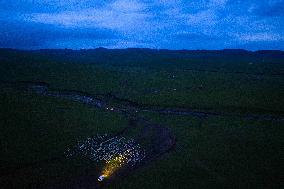
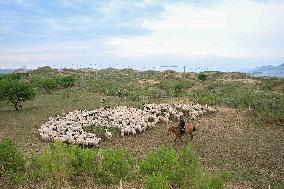
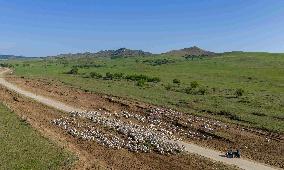
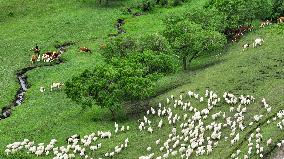
An aerial drone photo taken on June 14, 2025 shows herdsmen driving the livestock at night on the way to the summer campsite on Ar Horqin Grassland, Chifeng City of north China's Inner Mongolia Autonomous Region. Saintsogt, 55, a herdsman in Bayin-undur of Ar Horqin Banner, north China's Inner Mongolia Autonomous Region, is busy with the annual summer migration covering a distance of about 100 kilometers. For the past four decades, he has completed the migration every year. Saintsogt's pasture is a part of the Ar Horqin Grassland Nomadic System, which was listed as one of the Globally Important Agricultural Heritage Systems (GIAHS) sites by the United Nations Food and Agriculture Organization (FAO) on May 20, 2022. Herders here still keep the traditional nomadic customs today. "The travel time has been shortened to three days from eight," Saintsogt said. "The rain makes pasture grow better, and the livestock have enough forage." This year, herders from more than 1,200 households and 128,000 livestock in Bayin

  •  
Nomadic Life in Inner Mongolia's Horqin Grassland - China

Nomadic Life in Inner Mongolia's Horqin Grassland - China

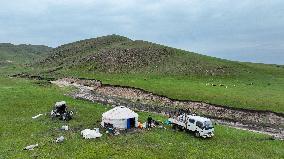
An aerial drone photo taken on June 15, 2025 shows a Mongolian yurt of Saintsogt at his summer campsite on Ar Horqin Grassland, Chifeng City of north China's Inner Mongolia Autonomous Region. Saintsogt, 55, a herdsman in Bayin-undur of Ar Horqin Banner, north China's Inner Mongolia Autonomous Region, is busy with the annual summer migration covering a distance of about 100 kilometers. For the past four decades, he has completed the migration every year. Saintsogt's pasture is a part of the Ar Horqin Grassland Nomadic System, which was listed as one of the Globally Important Agricultural Heritage Systems (GIAHS) sites by the United Nations Food and Agriculture Organization (FAO) on May 20, 2022. Herders here still keep the traditional nomadic customs today. "The travel time has been shortened to three days from eight," Saintsogt said. "The rain makes pasture grow better, and the livestock have enough forage." This year, herders from more than 1,200 households and 128,000 livestock in Bayin-undur joined the mig

  •  
Nomadic Life in Inner Mongolia's Horqin Grassland - China

Nomadic Life in Inner Mongolia's Horqin Grassland - China

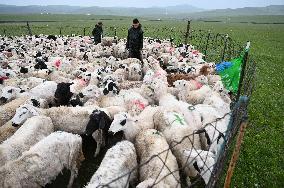
Saintsogt's son (2nd R) drives sheep in rain on his way to the summer campsite on Ar Horqin Grassland, Chifeng City of north China's Inner Mongolia Autonomous Region, June 13, 2025. Saintsogt, 55, a herdsman in Bayin-undur of Ar Horqin Banner, north China's Inner Mongolia Autonomous Region, is busy with the annual summer migration covering a distance of about 100 kilometers. For the past four decades, he has completed the migration every year. Saintsogt's pasture is a part of the Ar Horqin Grassland Nomadic System, which was listed as one of the Globally Important Agricultural Heritage Systems (GIAHS) sites by the United Nations Food and Agriculture Organization (FAO) on May 20, 2022. Herders here still keep the traditional nomadic customs today. "The travel time has been shortened to three days from eight," Saintsogt said. "The rain makes pasture grow better, and the livestock have enough forage." This year, herders from more than 1,200 households and 128,000 livestock in Bayin-undur joined the migration. Ph

  •  
Nomadic Life in Inner Mongolia's Horqin Grassland - China

Nomadic Life in Inner Mongolia's Horqin Grassland - China

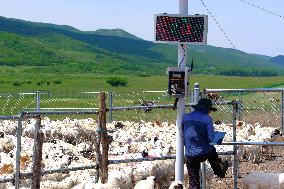
A staff member of Gogodtai Han Ul national nature reserve counts the livestock entering the nature reserve in north China's Inner Mongolia Autonomous Region, June 14, 2025. Saintsogt, 55, a herdsman in Bayin-undur of Ar Horqin Banner, north China's Inner Mongolia Autonomous Region, is busy with the annual summer migration covering a distance of about 100 kilometers. For the past four decades, he has completed the migration every year. Saintsogt's pasture is a part of the Ar Horqin Grassland Nomadic System, which was listed as one of the Globally Important Agricultural Heritage Systems (GIAHS) sites by the United Nations Food and Agriculture Organization (FAO) on May 20, 2022. Herders here still keep the traditional nomadic customs today. "The travel time has been shortened to three days from eight," Saintsogt said. "The rain makes pasture grow better, and the livestock have enough forage." This year, herders from more than 1,200 households and 128,000 livestock in Bayin-undur joined the migration. Photo by Ma

  •  
Nomadic Life in Inner Mongolia's Horqin Grassland - China

Nomadic Life in Inner Mongolia's Horqin Grassland - China

Saintsogt's son seeks for a sick sheep after arriving at the summer campsite on Ar Horqin Grassland, Chifeng City of north China's Inner Mongolia Autonomous Region, June 15, 2025. Saintsogt, 55, a herdsman in Bayin-undur of Ar Horqin Banner, north China's Inner Mongolia Autonomous Region, is busy with the annual summer migration covering a distance of about 100 kilometers. For the past four decades, he has completed the migration every year. Saintsogt's pasture is a part of the Ar Horqin Grassland Nomadic System, which was listed as one of the Globally Important Agricultural Heritage Systems (GIAHS) sites by the United Nations Food and Agriculture Organization (FAO) on May 20, 2022. Herders here still keep the traditional nomadic customs today. "The travel time has been shortened to three days from eight," Saintsogt said. "The rain makes pasture grow better, and the livestock have enough forage." This year, herders from more than 1,200 households and 128,000 livestock in Bayin-undur joined the migration. Phot

  •  
Nomadic Life in Inner Mongolia's Horqin Grassland - China

Nomadic Life in Inner Mongolia's Horqin Grassland - China

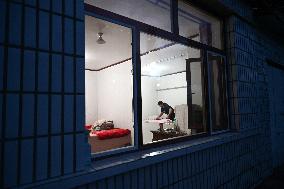
Saintsogt's wife arranges bedding at home before departing for the summer campsite on Ar Horqin Grassland, Chifeng City of north China's Inner Mongolia Autonomous Region, June 13, 2025. Saintsogt, 55, a herdsman in Bayin-undur of Ar Horqin Banner, north China's Inner Mongolia Autonomous Region, is busy with the annual summer migration covering a distance of about 100 kilometers. For the past four decades, he has completed the migration every year. Saintsogt's pasture is a part of the Ar Horqin Grassland Nomadic System, which was listed as one of the Globally Important Agricultural Heritage Systems (GIAHS) sites by the United Nations Food and Agriculture Organization (FAO) on May 20, 2022. Herders here still keep the traditional nomadic customs today. "The travel time has been shortened to three days from eight," Saintsogt said. "The rain makes pasture grow better, and the livestock have enough forage." This year, herders from more than 1,200 households and 128,000 livestock in Bayin-undur joined the migration

  •  
Nomadic Life in Inner Mongolia's Horqin Grassland - China

Nomadic Life in Inner Mongolia's Horqin Grassland - China

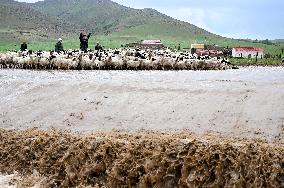
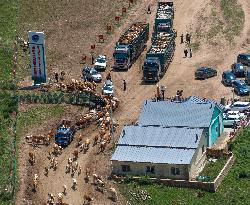
An aerial drone photo taken on June 14, 2025 shows herders waiting for entering the Gogodtai Han Ul national nature reserve in north China's Inner Mongolia Autonomous Region. Saintsogt, 55, a herdsman in Bayin-undur of Ar Horqin Banner, north China's Inner Mongolia Autonomous Region, is busy with the annual summer migration covering a distance of about 100 kilometers. For the past four decades, he has completed the migration every year. Saintsogt's pasture is a part of the Ar Horqin Grassland Nomadic System, which was listed as one of the Globally Important Agricultural Heritage Systems (GIAHS) sites by the United Nations Food and Agriculture Organization (FAO) on May 20, 2022. Herders here still keep the traditional nomadic customs today. "The travel time has been shortened to three days from eight," Saintsogt said. "The rain makes pasture grow better, and the livestock have enough forage." This year, herders from more than 1,200 households and 128,000 livestock in Bayin-undur joined the migration. Photo by

  •  
Nomadic Life in Inner Mongolia's Horqin Grassland - China

Nomadic Life in Inner Mongolia's Horqin Grassland - China

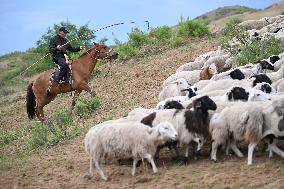
Saintsogt gathers the livestock at the winter campsite before departing for the summer campsite on Ar Horqin Grassland, Chifeng City of north China's Inner Mongolia Autonomous Region, June 13, 2025. Saintsogt, 55, a herdsman in Bayin-undur of Ar Horqin Banner, north China's Inner Mongolia Autonomous Region, is busy with the annual summer migration covering a distance of about 100 kilometers. For the past four decades, he has completed the migration every year. Saintsogt's pasture is a part of the Ar Horqin Grassland Nomadic System, which was listed as one of the Globally Important Agricultural Heritage Systems (GIAHS) sites by the United Nations Food and Agriculture Organization (FAO) on May 20, 2022. Herders here still keep the traditional nomadic customs today. "The travel time has been shortened to three days from eight," Saintsogt said. "The rain makes pasture grow better, and the livestock have enough forage." This year, herders from more than 1,200 households and 128,000 livestock in Bayin-undur joined

  •  
Nomadic Life in Inner Mongolia's Horqin Grassland - China

Nomadic Life in Inner Mongolia's Horqin Grassland - China

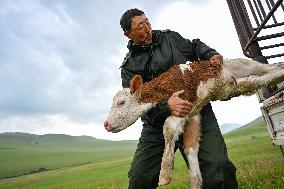
Saintsogt takes a newly born calf off the truck after arriving at the summer campsite on Ar Horqin Grassland, Chifeng City of north China's Inner Mongolia Autonomous Region, June 15, 2025. Saintsogt, 55, a herdsman in Bayin-undur of Ar Horqin Banner, north China's Inner Mongolia Autonomous Region, is busy with the annual summer migration covering a distance of about 100 kilometers. For the past four decades, he has completed the migration every year. Saintsogt's pasture is a part of the Ar Horqin Grassland Nomadic System, which was listed as one of the Globally Important Agricultural Heritage Systems (GIAHS) sites by the United Nations Food and Agriculture Organization (FAO) on May 20, 2022. Herders here still keep the traditional nomadic customs today. "The travel time has been shortened to three days from eight," Saintsogt said. "The rain makes pasture grow better, and the livestock have enough forage." This year, herders from more than 1,200 households and 128,000 livestock in Bayin-undur joined the migrat

  •  
Nomadic Life in Inner Mongolia's Horqin Grassland - China

Nomadic Life in Inner Mongolia's Horqin Grassland - China

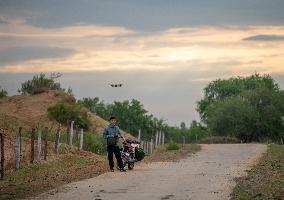
Saintsogt's son operates a drone to check the number of the livestock on Ar Horqin Grassland, Chifeng City of north China's Inner Mongolia Autonomous Region, June 13, 2025. Saintsogt, 55, a herdsman in Bayin-undur of Ar Horqin Banner, north China's Inner Mongolia Autonomous Region, is busy with the annual summer migration covering a distance of about 100 kilometers. For the past four decades, he has completed the migration every year. Saintsogt's pasture is a part of the Ar Horqin Grassland Nomadic System, which was listed as one of the Globally Important Agricultural Heritage Systems (GIAHS) sites by the United Nations Food and Agriculture Organization (FAO) on May 20, 2022. Herders here still keep the traditional nomadic customs today. "The travel time has been shortened to three days from eight," Saintsogt said. "The rain makes pasture grow better, and the livestock have enough forage." This year, herders from more than 1,200 households and 128,000 livestock in Bayin-undur joined the migration. Photo by Ma

  •  
Nomadic Life in Inner Mongolia's Horqin Grassland - China

Nomadic Life in Inner Mongolia's Horqin Grassland - China

An aerial drone photo taken on June 14, 2025 shows Saintsogt driving the livestock on his way to the summer campsite on Ar Horqin Grassland, Chifeng City of north China's Inner Mongolia Autonomous Region. Saintsogt, 55, a herdsman in Bayin-undur of Ar Horqin Banner, north China's Inner Mongolia Autonomous Region, is busy with the annual summer migration covering a distance of about 100 kilometers. For the past four decades, he has completed the migration every year. Saintsogt's pasture is a part of the Ar Horqin Grassland Nomadic System, which was listed as one of the Globally Important Agricultural Heritage Systems (GIAHS) sites by the United Nations Food and Agriculture Organization (FAO) on May 20, 2022. Herders here still keep the traditional nomadic customs today. "The travel time has been shortened to three days from eight," Saintsogt said. "The rain makes pasture grow better, and the livestock have enough forage." This year, herders from more than 1,200 households and 128,000 livestock in Bayin-undur j

  •  
Nomadic Life in Inner Mongolia's Horqin Grassland - China

Nomadic Life in Inner Mongolia's Horqin Grassland - China

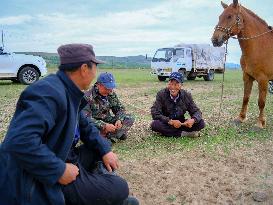
Saintsogt (R) talks with other herdsmen on their way to the summer campsite on Ar Horqin Grassland, Chifeng City of north China's Inner Mongolia Autonomous Region, June 13, 2025. Saintsogt, 55, a herdsman in Bayin-undur of Ar Horqin Banner, north China's Inner Mongolia Autonomous Region, is busy with the annual summer migration covering a distance of about 100 kilometers. For the past four decades, he has completed the migration every year. Saintsogt's pasture is a part of the Ar Horqin Grassland Nomadic System, which was listed as one of the Globally Important Agricultural Heritage Systems (GIAHS) sites by the United Nations Food and Agriculture Organization (FAO) on May 20, 2022. Herders here still keep the traditional nomadic customs today. "The travel time has been shortened to three days from eight," Saintsogt said. "The rain makes pasture grow better, and the livestock have enough forage." This year, herders from more than 1,200 households and 128,000 livestock in Bayin-undur joined the migration. Photo

  •  
Nomadic Life in Inner Mongolia's Horqin Grassland - China

Nomadic Life in Inner Mongolia's Horqin Grassland - China

Saintsogt gathers the livestock at their winter campsite before departing for the summer campsite on Ar Horqin Grassland, Chifeng City of north China's Inner Mongolia Autonomous Region, June 13, 2025. Saintsogt, 55, a herdsman in Bayin-undur of Ar Horqin Banner, north China's Inner Mongolia Autonomous Region, is busy with the annual summer migration covering a distance of about 100 kilometers. For the past four decades, he has completed the migration every year. Saintsogt's pasture is a part of the Ar Horqin Grassland Nomadic System, which was listed as one of the Globally Important Agricultural Heritage Systems (GIAHS) sites by the United Nations Food and Agriculture Organization (FAO) on May 20, 2022. Herders here still keep the traditional nomadic customs today. "The travel time has been shortened to three days from eight," Saintsogt said. "The rain makes pasture grow better, and the livestock have enough forage." This year, herders from more than 1,200 households and 128,000 livestock in Bayin-undur joine

  •  
Nomadic Life in Inner Mongolia's Horqin Grassland - China

Nomadic Life in Inner Mongolia's Horqin Grassland - China

An aerial drone photo shows Saintsogt's son (L) riding a motorcycle to drive the livestock on his way to the summer campsite on Ar Horqin Grassland, Chifeng City of north China's Inner Mongolia Autonomous Region, June 14, 2025. Saintsogt, 55, a herdsman in Bayin-undur of Ar Horqin Banner, north China's Inner Mongolia Autonomous Region, is busy with the annual summer migration covering a distance of about 100 kilometers. For the past four decades, he has completed the migration every year. Saintsogt's pasture is a part of the Ar Horqin Grassland Nomadic System, which was listed as one of the Globally Important Agricultural Heritage Systems (GIAHS) sites by the United Nations Food and Agriculture Organization (FAO) on May 20, 2022. Herders here still keep the traditional nomadic customs today. "The travel time has been shortened to three days from eight," Saintsogt said. "The rain makes pasture grow better, and the livestock have enough forage." This year, herders from more than 1,200 households and 128,000 liv

  •  
Nomadic Life in Inner Mongolia's Horqin Grassland - China

Nomadic Life in Inner Mongolia's Horqin Grassland - China

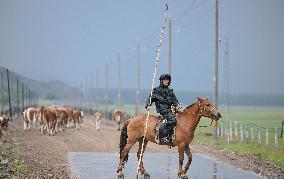
Saintsogt drives cattle in the rain on his way to the summer campsite on Ar Horqin Grassland, Chifeng City of north China's Inner Mongolia Autonomous Region, June 13, 2025. Saintsogt, 55, a herdsman in Bayin-undur of Ar Horqin Banner, north China's Inner Mongolia Autonomous Region, is busy with the annual summer migration covering a distance of about 100 kilometers. For the past four decades, he has completed the migration every year. Saintsogt's pasture is a part of the Ar Horqin Grassland Nomadic System, which was listed as one of the Globally Important Agricultural Heritage Systems (GIAHS) sites by the United Nations Food and Agriculture Organization (FAO) on May 20, 2022. Herders here still keep the traditional nomadic customs today. "The travel time has been shortened to three days from eight," Saintsogt said. "The rain makes pasture grow better, and the livestock have enough forage." This year, herders from more than 1,200 households and 128,000 livestock in Bayin-undur joined the migration. Photo by Be

  •  
Nomadic Life in Inner Mongolia's Horqin Grassland - China

Nomadic Life in Inner Mongolia's Horqin Grassland - China

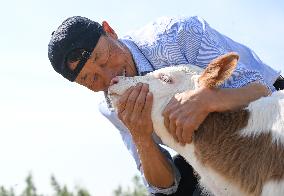
Saintsogt hugs a newly born calf on his way to the summer campsite on Ar Horqin Grassland, Chifeng City of north China's Inner Mongolia Autonomous Region, June 14, 2025. Saintsogt, 55, a herdsman in Bayin-undur of Ar Horqin Banner, north China's Inner Mongolia Autonomous Region, is busy with the annual summer migration covering a distance of about 100 kilometers. For the past four decades, he has completed the migration every year. Saintsogt's pasture is a part of the Ar Horqin Grassland Nomadic System, which was listed as one of the Globally Important Agricultural Heritage Systems (GIAHS) sites by the United Nations Food and Agriculture Organization (FAO) on May 20, 2022. Herders here still keep the traditional nomadic customs today. "The travel time has been shortened to three days from eight," Saintsogt said. "The rain makes pasture grow better, and the livestock have enough forage." This year, herders from more than 1,200 households and 128,000 livestock in Bayin-undur joined the migration. Photo by Bei H

  •  
Nomadic Life in Inner Mongolia's Horqin Grassland - China

Nomadic Life in Inner Mongolia's Horqin Grassland - China

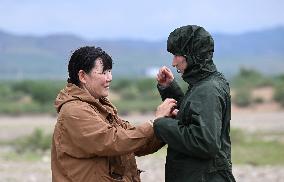
Saintsogt's wife (L) helps her son to wear a raincoat on their way to the summer campsite on Ar Horqin Grassland, Chifeng City of north China's Inner Mongolia Autonomous Region, June 13, 2025. Saintsogt, 55, a herdsman in Bayin-undur of Ar Horqin Banner, north China's Inner Mongolia Autonomous Region, is busy with the annual summer migration covering a distance of about 100 kilometers. For the past four decades, he has completed the migration every year. Saintsogt's pasture is a part of the Ar Horqin Grassland Nomadic System, which was listed as one of the Globally Important Agricultural Heritage Systems (GIAHS) sites by the United Nations Food and Agriculture Organization (FAO) on May 20, 2022. Herders here still keep the traditional nomadic customs today. "The travel time has been shortened to three days from eight," Saintsogt said. "The rain makes pasture grow better, and the livestock have enough forage." This year, herders from more than 1,200 households and 128,000 livestock in Bayin-undur joined the mi

  •  
Nomadic Life in Inner Mongolia's Horqin Grassland - China

Nomadic Life in Inner Mongolia's Horqin Grassland - China

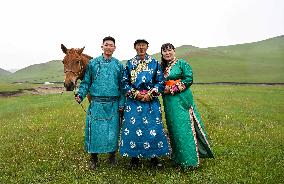
Saintsogt (C), his wife (R) and son pose for a group photo at their summer campsite on Ar Horqin Grassland, Chifeng City of north China's Inner Mongolia Autonomous Region, June 15, 2025. Saintsogt, 55, a herdsman in Bayin-undur of Ar Horqin Banner, north China's Inner Mongolia Autonomous Region, is busy with the annual summer migration covering a distance of about 100 kilometers. For the past four decades, he has completed the migration every year. Saintsogt's pasture is a part of the Ar Horqin Grassland Nomadic System, which was listed as one of the Globally Important Agricultural Heritage Systems (GIAHS) sites by the United Nations Food and Agriculture Organization (FAO) on May 20, 2022. Herders here still keep the traditional nomadic customs today. "The travel time has been shortened to three days from eight," Saintsogt said. "The rain makes pasture grow better, and the livestock have enough forage." This year, herders from more than 1,200 households and 128,000 livestock in Bayin-undur joined the migratio

  •  
CHINA-CHONGQING-FOREIGNER-TRAVEL-SERVICE (CN)

CHINA-CHONGQING-FOREIGNER-TRAVEL-SERVICE (CN)

(240709) -- CHONGQING, July 9, 2024 Photo by Xinhua/ABACAPRESS.COM) -- Hungarian football fans cheer for their home team's performance at the UEFA Euro 2024 group match, at a shopping park in Nanan district, in southwest China's Chongqing, June 20, 2024. Chongqing has handled more than 150,000 inbound and outbound foreign passengers in the first half of this year, 4.9 times that of the same period last year. With optimized visa policies, Chongqing keeps on improving the itinerary management for inbound tour groups, offering foreign travelers more flexible choices on the ports of entry and exit. Meanwhile, a visa coordination mechanism has been established between ports of Chongqing Municipality and Sichuan Province in southwest China. (Photo by Guo Xu/Xinhua/ABACAPRESS.COM

  •  
NORWAY-NY-ALESUND-POLAR DAY-SCENERY

NORWAY-NY-ALESUND-POLAR DAY-SCENERY

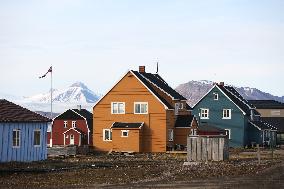
(240626) -- NY-ALESUND, June 26, 2024 Photo by Xinhua/ABACAPRESS.COM) -- This photo taken on June 20, 2024 shows the scenery of Ny-Alesund, Svalbard, Norway. As the world's northernmost permanent settlement, Ny-Alesund has four months of continuous daylight and four months of lasting darkness each year. From late April to late August, the sun never sets, treating visitors to the spectacle of the "midnight sun." Photo by Xinhua/ABACAPRESS.COM/Zhao Dingzhe)

  •  
NORWAY-NY-ALESUND-POLAR DAY-SCENERY

NORWAY-NY-ALESUND-POLAR DAY-SCENERY

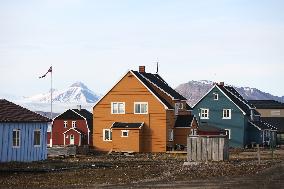
(240626) -- NY-ALESUND, June 26, 2024 (Xinhua) -- This photo taken on June 20, 2024 shows the scenery of Ny-Alesund, Svalbard, Norway. As the world's northernmost permanent settlement, Ny-Alesund has four months of continuous daylight and four months of lasting darkness each year. From late April to late August, the sun never sets, treating visitors to the spectacle of the "midnight sun." (Xinhua/Zhao Dingzhe)

  •  
CHINA-JIANGSU-YANGZHOU-HANGJI-TOOTHBRUSH-PRODUCTION (CN)

CHINA-JIANGSU-YANGZHOU-HANGJI-TOOTHBRUSH-PRODUCTION (CN)

(240622) -- YANGZHOU, June 22, 2024 Photo by Xinhua/ABACAPRESS.COM) -- This stitched aerial drone photo taken on June 20, 2024 shows robots working at an intelligent workshop of Jiangsu Sanxiao Group Co., Ltd in Hangji Township of Yangzhou City, east China's Jiangsu Province. Hangji Township, covering about 40 square kilometers, is located in the eastern suburbs of Yangzhou City in east China's Jiangsu Province. As an important production base for toothbrushes, the small town boasts over 2,000 toothbrush manufacturing and supporting enterprises and produces around 7.5 billion toothbrushes each year. They are exported to more than 80 countries and regions, meaning that one in three toothbrushes produced in the world comes from Hangji. In recent years, local government of Hangji has been encouraging enterprises to drive intelligent and digital transformation through technological innovation, relying on leading enterprises, e-commerce industrial parks, the toothbrush museum, and other resources to advance brand

  •  
CHINA-JIANGSU-YANGZHOU-HANGJI-TOOTHBRUSH-PRODUCTION (CN)

CHINA-JIANGSU-YANGZHOU-HANGJI-TOOTHBRUSH-PRODUCTION (CN)

(240622) -- YANGZHOU, June 22, 2024 Photo by Xinhua/ABACAPRESS.COM) -- This photo taken on June 20, 2024 shows the intelligent equipment producing toothbrushes at a toothbrush manufacturing enterprise in Hangji Township of Yangzhou City, east China's Jiangsu Province. Hangji Township, covering about 40 square kilometers, is located in the eastern suburbs of Yangzhou City in east China's Jiangsu Province. As an important production base for toothbrushes, the small town boasts over 2,000 toothbrush manufacturing and supporting enterprises and produces around 7.5 billion toothbrushes each year. They are exported to more than 80 countries and regions, meaning that one in three toothbrushes produced in the world comes from Hangji. In recent years, local government of Hangji has been encouraging enterprises to drive intelligent and digital transformation through technological innovation, relying on leading enterprises, e-commerce industrial parks, the toothbrush museum, and other resources to advance brand building

  •  
CHINA-JIANGSU-YANGZHOU-HANGJI-TOOTHBRUSH-PRODUCTION (CN)

CHINA-JIANGSU-YANGZHOU-HANGJI-TOOTHBRUSH-PRODUCTION (CN)

(240622) -- YANGZHOU, June 22, 2024 (Xinhua) -- This photo taken on June 20, 2024 shows the intelligent equipment producing toothbrushes at a toothbrush manufacturing enterprise in Hangji Township of Yangzhou City, east China's Jiangsu Province. Hangji Township, covering about 40 square kilometers, is located in the eastern suburbs of Yangzhou City in east China's Jiangsu Province. As an important production base for toothbrushes, the small town boasts over 2,000 toothbrush manufacturing and supporting enterprises and produces around 7.5 billion toothbrushes each year. They are exported to more than 80 countries and regions, meaning that one in three toothbrushes produced in the world comes from Hangji. In recent years, local government of Hangji has been encouraging enterprises to drive intelligent and digital transformation through technological innovation, relying on leading enterprises, e-commerce industrial parks, the toothbrush museum, and other resources to advance brand building and boost the dev

  •  
CHINA-JIANGSU-YANGZHOU-HANGJI-TOOTHBRUSH-PRODUCTION (CN)

CHINA-JIANGSU-YANGZHOU-HANGJI-TOOTHBRUSH-PRODUCTION (CN)

(240622) -- YANGZHOU, June 22, 2024 (Xinhua) -- This stitched aerial drone photo taken on June 20, 2024 shows robots working at an intelligent workshop of Jiangsu Sanxiao Group Co., Ltd in Hangji Township of Yangzhou City, east China's Jiangsu Province. Hangji Township, covering about 40 square kilometers, is located in the eastern suburbs of Yangzhou City in east China's Jiangsu Province. As an important production base for toothbrushes, the small town boasts over 2,000 toothbrush manufacturing and supporting enterprises and produces around 7.5 billion toothbrushes each year. They are exported to more than 80 countries and regions, meaning that one in three toothbrushes produced in the world comes from Hangji. In recent years, local government of Hangji has been encouraging enterprises to drive intelligent and digital transformation through technological innovation, relying on leading enterprises, e-commerce industrial parks, the toothbrush museum, and other resources to advance brand building and boost

  • Main
  • Top
  • Editorial
  • Creative
  • About Us
  • About ILG
  • Terms of use
  • Company
  • BEHIND
  • Price List
  • Single Plan
  • Monthly Plan
  • Services
  • Shooting
  • Rights Clearance
  • Support
  • FAQ
  • How To Buy
  • Contact Us
  • Become a Partner

© KYODO NEWS IMAGES INC

All Rights Reserved.

  • Editorial
  • Olympics
  • News
  • Sports
  • Japan
  • Tech
  • Royal
  • Disaster
  • NorthKorea
  • Old Japan
  • SNS
  • Creative
  • Food
  • Japan
  • Landscape
  • Animal
  • Popular
  • #Ukraine
  • #Thailand
  • #coronavirus
  • #N. Korea
  • #Russia
  • #China
  • #Ukraine
  • #Thailand
  • #coronavirus
  • #N. Korea
  • #Russia
  • #China
  • Food
  • Japan
  • Landscape
  • Animal
  • Olympics
  • News
  • Sports
  • Japan
  • Tech
  • Royal
  • Disaster
  • NorthKorea
  • Old Japan
  • SNS